Hi again,
the work continues on the bunker (and a wish to make it in a smaller scale instead!).
The list of things done is rather extensive, counting the fact I barely touched it in the past two weeks.
First, I had to peel the paint off, as mentioned in the last post.
Except for being rather messy, it actually gave the bunker a nice worn out look!
Next, I decided it needs the cuts in the roof to help keep water off it, and to give grass something to root into for camouflage (can't be seen on photos). I also started filling some holes with milliput and then I started working on the firing embrasures (a plate with three holes for the cloche, plus a single flank mounted machine-gun).
I also started preparing holes for ventilation, periscope and a grenade chute. Lastly, I sculpted a horrible stone wall that holds the mound of earth vertical at the entrance. I think I will redo it, but I would have to figure out how to make it look a bit more realistic.
What else can be seen is the fact that the turret in particular is very crooked, which is driving me mad. As usual, the lesson learned is that more time and attention should be invested in planning!
That's it for today!
Thanks for looking,
Mathyoo
Showing posts with label WW2. Show all posts
2 May 2016
17 Apr 2016
Bunker model - part 1
Hi guys,
I have honestly been working on more fantasy miniatures for a while, but then got preoccupied with other non-hobby things and have then - as usual - dived in a whole new project. I started making model of a bunker.
Should you be interested, the type chosen is a "Small Object". If you imagine a typical Casemate on the Maginot line, this would be it's smaller brother.
Modelling wise, this is a square bunker with a round turret on one of the side. It has a single heavy machine gun mounted in one of the sides. I decided to give this one a try because it's very, very recognisable and somewhat simple, without any odd shapes.
Strangely, I was unable to find many good sites on the internet about this kind of builds, but there are some people around that are making (mostly) Atlantik wall bunkers and some even actually make a wooden scaffolding and pour the concrete in.
I, however, went with the simpler approach and simply cut the general shape out of an insulation foam leftovers. I found a decent scale calculator online and set for a 1:48 model, which could potentially be used in 28mm games.
As you can see, my enthusiasm for precision work was abandoned very early.
After the general shape was constructed, I realised I am missing the protective heaps of earth around the bunker. The bunkers in my area were not dug in as the Blitzkrieg caught up with the construction workers, but I think having some earth around it adds to the visualisation.
Then it was all covered in plaster. Two or three times.
Back view with the entrance:
Yes, I do realise the earth is way unnatural. I plan on making another model in 1/100 where I could make the surrounds more natural and possibly put more types of bunkers on it for the sake of presentation.
When I got bored with plastering and sanding, I decided to give the model a coat or two of - and this is very important - cheap black paint.
Main weapon, a HMG would be mounted in the wall below:
There was a slight problem, however. I have intended to make further adjustments to the model after painting it, and when I've started scraping it, the paint peeled. I presume the bad paint quality, paired with thick coats (my bad!), that were put on before the paint fully dried (my bad!), with the added fact that the model was still dusty because of the sanding (I know!) had a lot to do with it.
I will show you the photos next time, but lets just say I've spent quite some time peeling the bugger off. The result was actually fantastic, as it gave bunker a bit of the "rustic" feel to it - but to no effect as it will be painted over.
More about it next time!
Mathyoo
I have honestly been working on more fantasy miniatures for a while, but then got preoccupied with other non-hobby things and have then - as usual - dived in a whole new project. I started making model of a bunker.
Should you be interested, the type chosen is a "Small Object". If you imagine a typical Casemate on the Maginot line, this would be it's smaller brother.
Modelling wise, this is a square bunker with a round turret on one of the side. It has a single heavy machine gun mounted in one of the sides. I decided to give this one a try because it's very, very recognisable and somewhat simple, without any odd shapes.
Strangely, I was unable to find many good sites on the internet about this kind of builds, but there are some people around that are making (mostly) Atlantik wall bunkers and some even actually make a wooden scaffolding and pour the concrete in.
I, however, went with the simpler approach and simply cut the general shape out of an insulation foam leftovers. I found a decent scale calculator online and set for a 1:48 model, which could potentially be used in 28mm games.
As you can see, my enthusiasm for precision work was abandoned very early.
After the general shape was constructed, I realised I am missing the protective heaps of earth around the bunker. The bunkers in my area were not dug in as the Blitzkrieg caught up with the construction workers, but I think having some earth around it adds to the visualisation.
Then it was all covered in plaster. Two or three times.
Back view with the entrance:
Yes, I do realise the earth is way unnatural. I plan on making another model in 1/100 where I could make the surrounds more natural and possibly put more types of bunkers on it for the sake of presentation.
When I got bored with plastering and sanding, I decided to give the model a coat or two of - and this is very important - cheap black paint.
Main weapon, a HMG would be mounted in the wall below:
There was a slight problem, however. I have intended to make further adjustments to the model after painting it, and when I've started scraping it, the paint peeled. I presume the bad paint quality, paired with thick coats (my bad!), that were put on before the paint fully dried (my bad!), with the added fact that the model was still dusty because of the sanding (I know!) had a lot to do with it.
I will show you the photos next time, but lets just say I've spent quite some time peeling the bugger off. The result was actually fantastic, as it gave bunker a bit of the "rustic" feel to it - but to no effect as it will be painted over.
More about it next time!
Mathyoo
26 Apr 2014
Trip to Balkans - part 2
Hello guys,
as my blog was found by the internet police, I would like to state right away the purpose of this post is not to talk about who's and what's but to simply show some facts that might be of interest to my usual readers, i.e. wargamers.
Today is an anniversary of establishment of "Liberation Front of the Slovene Nation", an anti-fascist Slovene organisation. Slovene partisans (formally called "National Liberation Army and Partisan Detachements of Slovenia). Long story short, OF (for "Osvobodilna fronta") was a group of all political groups, parties and organisations that have decided that armed resistance is a must in Slovenia. Communists were part of the OF, but were in minority at start. Eventually, their influence grew (mostly due to their experience in illegal operations, given the party was banned pre-war), but it is important to know not all the partisans were communists. This is important, because communists used the chance to also undertake a social revolution. If I simplify it, this lead to a civil war as some people "simply" found Communists to be bigger threat than Germans (especially after Italy was knocked out of the war). To this day, we (Slovenians) seem to have problems understanding who were the "good guys" and when politicians argue, it always comes down to who is "red" and who is "white" (as in white guard, from Russian revolution back in 1917). This is the reason I am reluctant to post much about local WW2. Most of it can be read about on Wiki, anyways. Below are some pictures, namely three posters and an Italian - German border in 1943.
This poster says "Red army welcome!" (okay "greeted" literally) in red and "on our soil" in black. It shows the friendly relations between USSR and Yugoslav (that's Yugoslav partisan flag there, Slovenian partisan flag would be white-blue-red, but other wise the same). The friendship was short lived as countries got "less friendly" after 1948. As an interesting fact, during Cold war, it was easier for Yugoslavs to travel to Paris than Moscow.
The poster above is from 1941 and shows Mussolini and Hitler grabbing our lands. The text says "Slovenes let's unite and defend ourselves!". Again, as an interesting fact, Slovenian territory was not a state in pre-war Yugoslavia.
Poster above is from 1942 I think. It shows ethnic Slovenian territory of that time (so it includes parts of today's Austria and Italy). On the picture you see valiant Slovenian farmer defending from German and Italian soldier, while he is getting back stabbed by a "bee gee" (B.G. -> Bela Garda -> White guard. This is how communist called forces that cooperated with the occupiers).
And below now is a photo I think you might find more interesting. It is an actual photo of 1943 border between Germany and Italy in then-village Šentvid (Saint Vitus). This village is now northern suburbia to Ljubljana - to give you a bit of an idea of it's location.
To keep the non-hobby posts to minimum, here are the rest of the interesting photos from my trip to Balkans:
Below is a huge WW1 memorial from Kraljevo. Again, as an interesting fact - during WW2 Germans have killed hundreds of civilians as a reprisal for German casualties in battles against Partisans and Chetniks (yes, same Chetniks that worked with Germans later in the war). I have managed to read somewhere on the internet that a lot of Slovenes that fled south during invasion were among the victims, too.
Also, as an interesting fact (I found no info about it on the internet) - Germans were so despised in the local cities after the war, that there were signs hanged warning German tourists that they are entering those cities at their own risk.
A close up on a statue - a Serbian soldier (mind the shoes!)
We were also visiting some centuries old monasteries. I have forgot how they are called, though. You can't take photos inside, so there is first one from outside the wall:
Second one was much better. It still has enormously high walls pretty much standing. I was so amazed I gathered all my knowledge of Serbian to politely ask a priest if I could take photos on the inside. I was quick to learn I can take a photo of anything I want - as long as I don't take shots of inside the church or a shop. That's too bad as there were some great frescos in there, but at least you can see the walls.
Main gate:
Church inside the monastery. When Serbian territory was invaded by Ottomans, this monastery was plundered. They also stole metal parts of the roof and thus water leaked in for centuries, ruining most of the frescoes.
Another shot of the walls:
Some ruins:
Below is a statue of Đorđe Petrović ("George Petrovich"), leader of Serbian uprising against Ottoman over rule. He was called "Karađorđ" - Black George by Turks.
King Petar the first's bust. He too, was from the House of Karađorđević. He was a Serbian king until 1918, when month-old State of Slovenes, Croats and Serbs (territories that used to belong to A-H empire) joined Kingdom of Serbia and country became known as a Kingdom of Serbs, Croats and Slovenes (yes, first and last nation swap places in formal name :P). This kingdom was renamed to Kingdom of Yugoslavia in 1929, when Aleksandar Karađorđević, Petar's son started his dictatorship.
Church of Saint George, where Petar I (and previously mentioned Black George) are buried now:
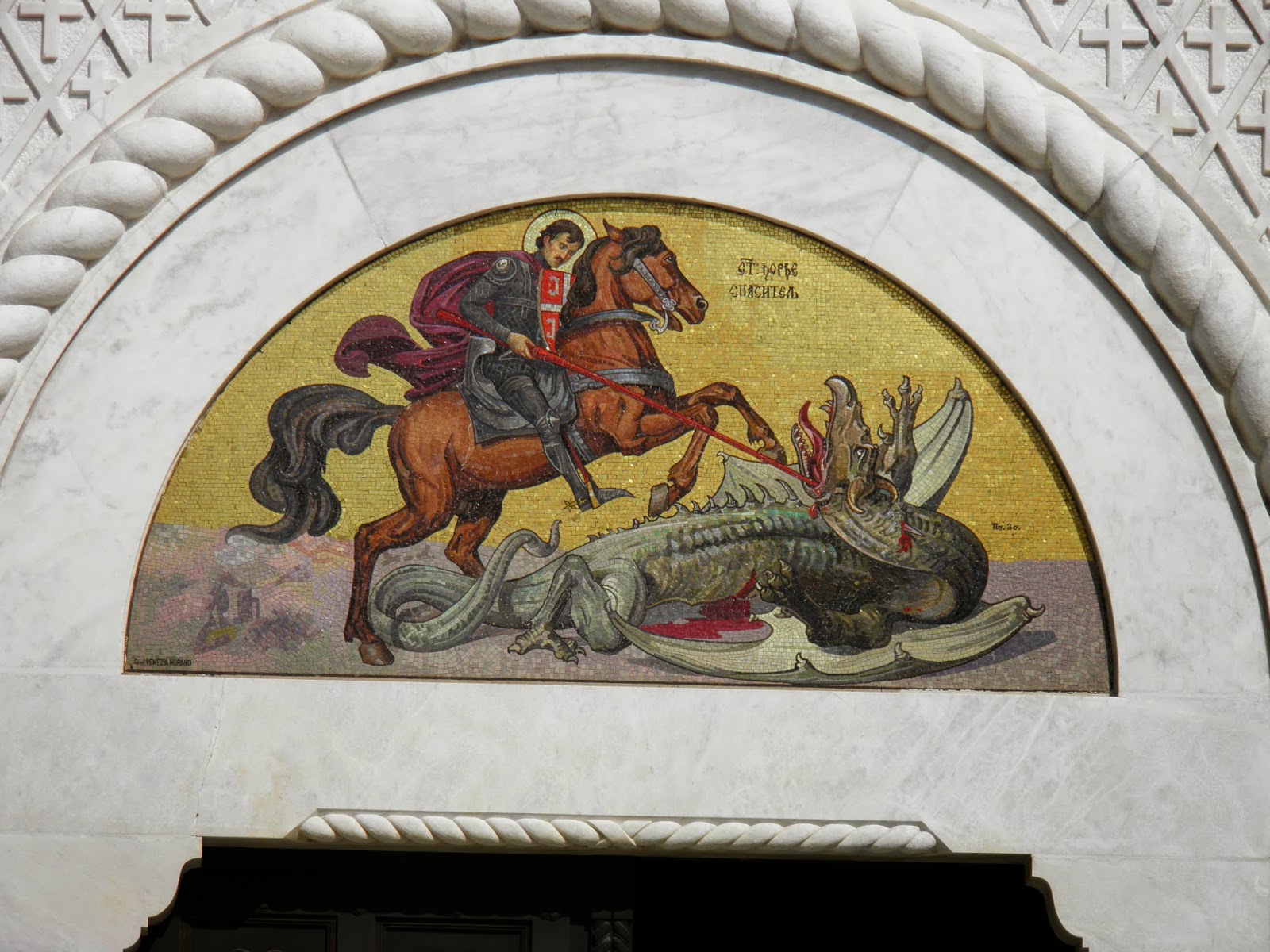
And a detail, because everyone loves Saint George and dragons.
Below is another statue of Black George guy - I have to admit my knowledge of Serbian history is pretty limited.
In the same park, there is also this nice piece of American hardware - a 75mm pack howitzer.
And it's carriage!
We also visited Avala , a hill close to Belgrade. There stands a very inspirational WW1 monument to "unknown hero". It's massive and it was bombarded by NATO in it's 1999 attack on near-by communications tower.
Tower was destroyed in 1999, but was repaired and reopened in 2010.
Our last stop worthy of mentioning was the Syrmian front memorial. Syrmian front was last axis front in Yugoslavia during WW2. After Belgrade was liberated by (at that time officially called) Yugoslav army and Red army, Axis forces took a stand here. After their positions were over run, German army and their local auxiliaries were engaged in constant fights all the way north - outside of Yugoslav territory and into (Brit controlled) Austria. Again, this is a huge memorial and actually a park.
The text says "12.IV.1945 Yugoslav army broke trough Syrmian front".
Entrance to the park:
A small church inside the park:
Look forward to the next park area. On those walls all the units that took part in this breakthrough are listed. And further on is another part with all the casualties. Road ends at the entrance to the museum, that was unfortunately closed at that time.
The text on the wall, signed by Tito say something like:
"We have 400 kilometers of front and every step is liberated with the blood of our best sons. Our national-liberation revolutionary army has led heavy battles with all German forces. Those that were in Yugoslavia all along and those that came to Yugoslavia from Greece and Albania. There was heavy fighting on Syrmian front. After our units have broke through in 1945, German forces were unable to stop and were constantly fighting on their way to Zagreb, Slovenia and Austrian border."
Interestingly, some units were written in Cyrillic and others were not - same with names of the fallen. Anyways, here is just one of the units that I found the most interesting - Brigade "Italy".
I hope this post proved as interesting as the former one. I will honestly show you some of my insurgents in my next post and hopefully I will be able to stick to hobby related posts for a while longer!
Thanks for looking,
Mathyoo
as my blog was found by the internet police, I would like to state right away the purpose of this post is not to talk about who's and what's but to simply show some facts that might be of interest to my usual readers, i.e. wargamers.
Today is an anniversary of establishment of "Liberation Front of the Slovene Nation", an anti-fascist Slovene organisation. Slovene partisans (formally called "National Liberation Army and Partisan Detachements of Slovenia). Long story short, OF (for "Osvobodilna fronta") was a group of all political groups, parties and organisations that have decided that armed resistance is a must in Slovenia. Communists were part of the OF, but were in minority at start. Eventually, their influence grew (mostly due to their experience in illegal operations, given the party was banned pre-war), but it is important to know not all the partisans were communists. This is important, because communists used the chance to also undertake a social revolution. If I simplify it, this lead to a civil war as some people "simply" found Communists to be bigger threat than Germans (especially after Italy was knocked out of the war). To this day, we (Slovenians) seem to have problems understanding who were the "good guys" and when politicians argue, it always comes down to who is "red" and who is "white" (as in white guard, from Russian revolution back in 1917). This is the reason I am reluctant to post much about local WW2. Most of it can be read about on Wiki, anyways. Below are some pictures, namely three posters and an Italian - German border in 1943.
This poster says "Red army welcome!" (okay "greeted" literally) in red and "on our soil" in black. It shows the friendly relations between USSR and Yugoslav (that's Yugoslav partisan flag there, Slovenian partisan flag would be white-blue-red, but other wise the same). The friendship was short lived as countries got "less friendly" after 1948. As an interesting fact, during Cold war, it was easier for Yugoslavs to travel to Paris than Moscow.
The poster above is from 1941 and shows Mussolini and Hitler grabbing our lands. The text says "Slovenes let's unite and defend ourselves!". Again, as an interesting fact, Slovenian territory was not a state in pre-war Yugoslavia.
Poster above is from 1942 I think. It shows ethnic Slovenian territory of that time (so it includes parts of today's Austria and Italy). On the picture you see valiant Slovenian farmer defending from German and Italian soldier, while he is getting back stabbed by a "bee gee" (B.G. -> Bela Garda -> White guard. This is how communist called forces that cooperated with the occupiers).
And below now is a photo I think you might find more interesting. It is an actual photo of 1943 border between Germany and Italy in then-village Šentvid (Saint Vitus). This village is now northern suburbia to Ljubljana - to give you a bit of an idea of it's location.
To keep the non-hobby posts to minimum, here are the rest of the interesting photos from my trip to Balkans:
Below is a huge WW1 memorial from Kraljevo. Again, as an interesting fact - during WW2 Germans have killed hundreds of civilians as a reprisal for German casualties in battles against Partisans and Chetniks (yes, same Chetniks that worked with Germans later in the war). I have managed to read somewhere on the internet that a lot of Slovenes that fled south during invasion were among the victims, too.
Also, as an interesting fact (I found no info about it on the internet) - Germans were so despised in the local cities after the war, that there were signs hanged warning German tourists that they are entering those cities at their own risk.
A close up on a statue - a Serbian soldier (mind the shoes!)
We were also visiting some centuries old monasteries. I have forgot how they are called, though. You can't take photos inside, so there is first one from outside the wall:
Second one was much better. It still has enormously high walls pretty much standing. I was so amazed I gathered all my knowledge of Serbian to politely ask a priest if I could take photos on the inside. I was quick to learn I can take a photo of anything I want - as long as I don't take shots of inside the church or a shop. That's too bad as there were some great frescos in there, but at least you can see the walls.
Main gate:
Church inside the monastery. When Serbian territory was invaded by Ottomans, this monastery was plundered. They also stole metal parts of the roof and thus water leaked in for centuries, ruining most of the frescoes.
Another shot of the walls:
Some ruins:
Below is a statue of Đorđe Petrović ("George Petrovich"), leader of Serbian uprising against Ottoman over rule. He was called "Karađorđ" - Black George by Turks.
King Petar the first's bust. He too, was from the House of Karađorđević. He was a Serbian king until 1918, when month-old State of Slovenes, Croats and Serbs (territories that used to belong to A-H empire) joined Kingdom of Serbia and country became known as a Kingdom of Serbs, Croats and Slovenes (yes, first and last nation swap places in formal name :P). This kingdom was renamed to Kingdom of Yugoslavia in 1929, when Aleksandar Karađorđević, Petar's son started his dictatorship.
Church of Saint George, where Petar I (and previously mentioned Black George) are buried now:
And a detail, because everyone loves Saint George and dragons.
Below is another statue of Black George guy - I have to admit my knowledge of Serbian history is pretty limited.
In the same park, there is also this nice piece of American hardware - a 75mm pack howitzer.
And it's carriage!
We also visited Avala , a hill close to Belgrade. There stands a very inspirational WW1 monument to "unknown hero". It's massive and it was bombarded by NATO in it's 1999 attack on near-by communications tower.
Tower was destroyed in 1999, but was repaired and reopened in 2010.
Our last stop worthy of mentioning was the Syrmian front memorial. Syrmian front was last axis front in Yugoslavia during WW2. After Belgrade was liberated by (at that time officially called) Yugoslav army and Red army, Axis forces took a stand here. After their positions were over run, German army and their local auxiliaries were engaged in constant fights all the way north - outside of Yugoslav territory and into (Brit controlled) Austria. Again, this is a huge memorial and actually a park.
The text says "12.IV.1945 Yugoslav army broke trough Syrmian front".
Entrance to the park:
A small church inside the park:
Look forward to the next park area. On those walls all the units that took part in this breakthrough are listed. And further on is another part with all the casualties. Road ends at the entrance to the museum, that was unfortunately closed at that time.
The text on the wall, signed by Tito say something like:
"We have 400 kilometers of front and every step is liberated with the blood of our best sons. Our national-liberation revolutionary army has led heavy battles with all German forces. Those that were in Yugoslavia all along and those that came to Yugoslavia from Greece and Albania. There was heavy fighting on Syrmian front. After our units have broke through in 1945, German forces were unable to stop and were constantly fighting on their way to Zagreb, Slovenia and Austrian border."
Interestingly, some units were written in Cyrillic and others were not - same with names of the fallen. Anyways, here is just one of the units that I found the most interesting - Brigade "Italy".
I hope this post proved as interesting as the former one. I will honestly show you some of my insurgents in my next post and hopefully I will be able to stick to hobby related posts for a while longer!
Thanks for looking,
Mathyoo
Subscribe to:
Comments (Atom)